

“Content Marketing” is a buzz word that has been doing the rounds over the last year or so. Call me cynical, but it is just a fancy word for blogging to me. It refers to using blogs to help promote a brand, product, or service. It also refers to using content to help retain your customers.
One of the reasons I have got more freelancing work over the last few years is because of the growth of “Content Marketing”. The changes made by search engines such as Google meant that SEO companies could no longer rely on sneaky black hat techniques that had been working before. They had to either start producing content for clients or getting links to their clients’ websites into content on other websites.
Anyone who owns a website will know that finding the right writer for your website can be a time-consuming task. The standard of submissions from applications is generally poor and the process of emailing possible writers back and fourth is tiring. Then you need to spend time editing and correcting articles that have been submitted.
I have spoken about this issue extensively in the past in such articles as “8 Reasons Freelance Bloggers are Not Finding Work” and “The Problems You Face When Hiring Bloggers“. I was reminded of this struggle recently after reading an article by my friend Jean Galea in which he spoke about the poor submissions he received for a job he advertised.
It does not take long for a website owner to realise that a good writer is worth his wait in gold.
That being said, there is an alternative route to go down. Rather than dealing with writers directly, you can purchase articles directory online.
There are a few services online that do this but the one that I keep coming across is Constant Content.
Constant Content – How it Works
The concept behind Constant Content is simple.
The service has a huge pool of writers at their disposal. Their home page claims they have over 100,000 writers on their books, but I imagine that number refers to the number of people who have signed up and not the number of writers who are actively working through the website.
A quick look at their writers search page shows that most articles are being written by a small group of people.

As a website owner, you can choose to acquire content in a number of ways.
If you need need something unique covered, you can order custom content. This works in a similar way to hiring writers directly yourself, but you save yourself a lot of hassle with screening writers and dealing with time wasters.
The big selling point of Constant Content is the ability to purchase content instantly. You can buy unique copyscape checked content on dozens of different topics instantly.
You can search by keyword, by category, or both. You can also define factors such as usage rights, cost, and article length, to help you find your perfect article.
A preview of each article is displayed to website owners. This preview is displayed as an image so that no part of the article is indexed by search engines.
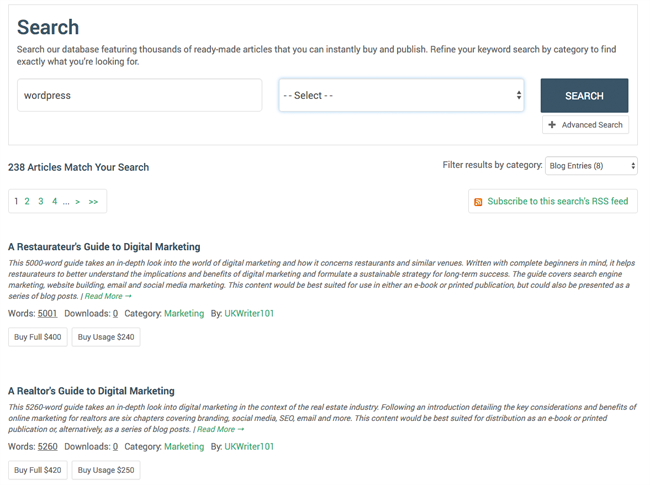
Each article listing shows the number of words in the article, the number of downloads, the article category, and the writer.
I really love how you can see a profile of each author. It allows you to see the total number of articles they have completed and contact the author directly about a possible writing job.
If an article has never been purchased, you will see an option to buy the article outright and gain full rights to the article and you will see an option to simply buy usage.
In my opinion, you should always buy the article outright. It makes sense from an SEO point of view and there is normally little difference between the two in pricing. For example, with some articles the cost of gaining full rights to the article and the cost of simply using it are identical. For other articles there is only a slight difference in price.
If someone buys an article outright, it is removed from Constant Content and no longer available for purchase. If someone buys usage, the option to buy it outright disappears but others can still choose to purchase usage rights. I came across some articles that had been downloaded several times. This is obviously good for the author who wrote the article, but it makes me wonder why those website owners didn’t simply purchase another article.
The cost of purchasing a pre-written article varies. There are articles around 500 words that can be purchased for around $25. There are also articles that are over 5,000 words that cost around $400. As you would expect, the better writers tend to charge more.
Please bear in mind that when you purchase an article from an article directory you just get the text and links etc. All you need to do is add images and videos to brighten the article up and make it look more professional.
Writing for Constant Content
From a time perspective, there are many pros to writing for Constant Content.
If you are simply submitting articles to the directory, you don’t have to spend time emailing clients back and fourth. Anyone who does a lot of writing will understand the benefits to this. It could make the difference between producing five articles per day and producing three or four.
If someone chooses to download your article, you could generate a commission multiple times for one article.
The problem with this setup is that you do not generate any income unless someone buys your article. There are thousands of articles in Constant Content’s directory and your articles could sit there in their directory for months or even years before being sold. They might never be sold.
On the Constant Content writer frequently asked questions page they note that you only have to earn $5 in order to be paid. Whilst the payment threshold is low, Constant Content take a commission of 35%.
Article directories are frequently used by SEO companies and there is sometimes a race to the bottom for pricing. Whilst $25 for a 500 word article seems great for the buyer, it means the author is only making $16.25. That’s just over three cents per word; which is a pretty terrible rate.
You do, of course, have the ability to set your own rates, however setting your article prices too high makes it less likely your article will be sold. If you’re lucky, your article will be downloaded multiple times to help offset reducing the cost of your articles.
When you contribute an article for Constant Content, you do not have to spend time cropping images etc. Therefore, you should be able to complete articles much quicker than you would for a blog.
If you can churn out articles all day long and not burn yourself out, you might be able to make money through Constant Content as an author, but my advice would be to bloggers would be to first find work directly through job boards such as ProBlogger and BloggingPro.
Final Thoughts
Constant Content is by no means the ultimate solution for producing content online, however I am sure that many of you will find it useful. If you are looking for content for a new project you can purchase unique articles instantly and fairly cheaply.
Writers may find making money through Constant Content difficult and inconsistent; particularly in the beginning. I suspect income gets better once you raise your profile. The main downside to this is that you are only raising your profile on Constant Content instead of getting your name out there on multiple websites.
I encourage you to check the service out and keep it mind for future projects.
Thanks for reading.
Kevin
I doubt it, they have always been very professional in my observations. The most likely scenario: She submitted an article and it was rejected; she mouthed off to the editor about it, and never learned from the mistake that got her article rejected in the first place. I could be wrong, but I doubt it. The only way you can communicate with the editor is through the re-submission page, as far as I’m aware, and I sincerely doubt they are not justified in rejecting your articles; even if their reasoning is simply that you were mean. Maybe you should apologize and accept some fault for you own actions/shortcomings.
Sorry to hear that. There are always going to be upset writers with a service like this, but it sounds like they have been unprofessional in this instance.
Whatever you do when writing for Constant Content, do not get on Shari Stewart’s bad side. I wrote 120 articles for the site, 80 of which were sold. Then for some reason Shari took a dislike to me and told all the editors to reject my work, instructing them to state that my articles contained too many grammar, spelling and punctuation errors. Scared out of my wits of making mistakes, I sent my last article to a friend who is a professional editor. Someone who works for The New York Times no less. And guess what, it was rejected stating that the article contained too many grammar, spelling and punctuation mistakes. I’m actively looking into who owns Constant Content so I can file a formal complaint against Shari Steward for discrimination.
Interesting theme, thanks! Constant Content is new for me. I think it can be really good assistant fore those who starting blogging, but can’t solve all problems with the content.
As far as I can tell from reading a fair amount about the company from various sources across the Web, Kimsufi has created a viable business model out of assembling huge racks of ultra-cheap servers that they build themselves from low-cost components and host in converted shipping containers. I think Kimsufi even designs its own motherboards for manufacturing in some outsourced factory in Taiwan or China.
Their servers appear to be actual servers. The major catch is that they are totally unmanaged. The only thing Kimsufi’s technicians will do for an existing customer is replace a broken server. The company’s several data centers do have a decent system for automatically installing a wide variety of preconfigured operating systems, though.
I’m a little surprised you didn’t know about Kimsufi. It’s essentially a division of OVH, which you appear to use yourself. I’m guessing you’ve gone with OVH’s “So You Start” server offerings.
https://ovh.com/us/news/cp1355.the_ovh_offering_expands_with_new_lines_of_dedicated_servers
If you’re paying $12 per month, you don’t have a dedicated server. Sounds like you have a VPS.
Ehhh — the low-end Kimsufi dedicated server only costs like $12 a month for a reasonably effective CPU hooked up with 4GB of DRAM and 40GB of SSD goodness. It’s mostly meant to be a test bed for learning server-administration skills, but if it’s there anyway, I might as well plop the potentially high-activity and high-bandwidth writer’s website on it. Using a cheap server for the website also means not having to worry about a shared hosting provider squawking in my ear about excessive resource consumption by a beta website with so many restless plugins that one fears a worker’s revolution. ^_^
Wow. Sounds like you have a lot of things in motion. Best of luck with it all.
I would stop paying for a dedicated server unless you are using it. It’s just a waste of money unless you need that amount of resources. Additionally, you could gain all the knowledge you need from managing an unmanaged VPS.
No, no, Mr. Muldoon — I do write for at least two other content brokers with one of them accounting for the great bulk of my activity. Constant Content was an inactive possibility that I’m now bringing up to date with a small but significant body of speculative work. I’ve had a top rating at my primary venue for freelance writing for a few years now, and it seemed time to branch out.
I’m also about to launch a minor side effort with proofreading at Fiverr, which apparently allows much larger fees as “extras” that are in reality rather indispensable to a complete project. The nominal “five-buck” project offering persists mostly as a teaser that displays the talents of the freelancer for new clients who might want to blow a few bucks on a small sample project before laying out bigger bucks for what might prove to be a pig in a poke.
Furthermore, I’ve been ramping up to a full-out writer’s website on a domain name that has been in my portfolio for a few years, but that awaits completion of the aforementioned WordPress research. Security against spamming and cracker attacks is obviously a high priority, and administrative capabilities, multi-level caching, reliable backup options, SEO functionality and lead-capturing pathways are similarly indispensable considerations. Playing with Google Maps also seems a worthwhile experiment, and a fair number of other ideas cry out for testing on a beta website.
Complicating the issue still further is the steep learning curve attached to mastering the management of a small dedicated server from Kimsufi. I haven’t yet had time to pay proper attention to the do-it-yourself implications of this totally unmanaged server, so it sits there month after month, sipping away at the meager contents of my bank account. Fortunately, the shared hosting accounts that currently harbor my active websites cost remarkably little to support!
Until the later stages of a great deal of preparatory work, my existing websites will remain small, unimaginative exhibitions of default WordPress goodness, simple-minded Drupal experimentation or even pure HTML simplicity. :^]
In truth, I have indeed been contemplating the specific niche of writing directly for website owners, but so far, this mulling has been focused on the possibility of cold-contacting privately owned dental practices, small law firms, local health services and other smaller concerns. I hadn’t thought as such of the wider marketplace of blog owners. One hears stories of difficulties with timely payment and demanding clients who keep adjusting the goalposts. It’s something to consider, though!
It sounds like you are doing well through it Firth. Good to hear.
I was quite surprised you said you only write for Constant Content. Have you not tried to seek work elsewhere? Have you not considered launching your own website or writing directly for a website owner?
Kevin
Ah! I also meant to ask you about WordPress. Over the last couple of months, I’ve been gradually accumulating a list of unusually functional, highly rated and reasonably bug-free plugins. It’s been very slow going in part because the free WordPress plugin directory is much more freewheeling and chaotic than the “thou shalt not duplicate functionality without dire need” attitude of the authors of Drupal modules. O_o
Needless to say, there have thus far been many pleasant surprises along with the usual dreary expressions of incompetence, mission bloat and even greed destroying what had once been useful plugins. I’m looking at you, Yoast SEO and Jetpack. It’s much too early to say for certain, but I expect that the total number of carefully curated plugins will number about 200–280 after I’m finally finished in another two or three months. Ach mein Gott, there are so many of them, and the search function at WordPress.org sucks donkey balls. Even the rather less extensive module collection for Drupal’s far more rational approach took nearly three months of on-and-off slogging. -_-
Anyways, my question is as follows. What have you found to be the best WordPress plugins for a responsive, capable website for someone who likes to push the envelope of functionality without ditzing around with buggy plugins that promise only pain and despair? Is such a list already on your website? Please forgive me if I’ve missed it! Furthermore, please feel free to move this comment to a more appropriate thread if you feel it necessary. ^_^
Gracious — I didn’t mean to give the wrong impression. I only write for Constant Content. I have a perhaps obsessive habit of repeatedly conducting further research on the various content brokers for which I might produce work, and I found your website in the course of octopusing Google for mentions of Constant Content. I had been especially concerned about reports of system-wide glitchiness for authors ever since the website’s sudden change to a modernized, “responsive” design.
That’s why I asked about the buyer’s side — the sad faces seemed mostly confined to newer authors who apparently had difficulty with communicating with buyers through the website. Constant Content’s backroom team may yet be struggling to cope with the unexpected fallout from a major website upgrade. I still have hopes myself of being able to make a little money through Constant Content, though!
In any case, over the past three years of on-and-off research on Constant Constant, virtually every comment I’ve seen on the Web about the actual quality of the articles available at Constant Content has been positive. Make of that what you will. :^)
Finally, part of the reason I’m returning at last to Constant Content is a bad habit of perfectionism. I just cannot bring myself to dash out sloppy work if I can possibly help it. That means slow writing, which in turn means asking higher rates for what one hopes to be more polished work. It’s hard to say whether or not this approach will pan out, but it’s worth a try.
I’ve been setting the nominal per-word rates for my speculative pieces to a level that should over time result in an overall compensation of about $0.05 per word, accounting for Constant Content’s 35-percent commission and a reasonable clearance rate of 60 percent for all posted articles. Selling more or fewer of these speculative articles will affect the total return on words written, naturally. We shall see what happens.
I remember seeing the website previously but I never used it. It was only recently that I came across it again. How have you found the quality of content on offer?
After having opened an account at Constant Content a few years back, I’m finally adding to the single article I had there with more articles as time permits. The new “responsive” website seems to have its quirks, nor does changing browsers help. I’m curious — have you actually been able to buy articles there without difficulty in recent weeks or even months? Is the user interface clunky for you as a buyer? Is it better or worse than it was prior to the redesign that evidently took place in the summer of 2015?