
Two days ago I ran my first ever race in Manchester, England. It was, as you would expect, an eventful experience.
The Greater Manchester Marathon is ran by ten thousand people every year. I was running the marathon as part of The Crohn’s 4 Marathon Challenge: a challenge that myself and my friend Barry have set ourselves in order to raise money for Crohn’s and Colitis UK.
Preparing for the Race
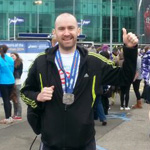
My preparation for the race was far from perfect. I pulled my hamstring around a month before the marathon. This meant that I could not do any real training in the run up to the event apart from a few short runs and one ten mile run.
When I should have been out running, I was indoors resting and icing. Yet the ten mile run I did the week before the event hinted that my general fitness had not been affected.
A few days before the event, we started loading up on carbs. This increases the amount of glycogen that is stored in your body for the event. I am unsure as to whether we did it correctly or not as I felt a bit bloated when doing it and I had never relied on extensive carb loading for my eighteen and twenty mile runs. However, the scientific studies that are available show that is is beneficial.
We travelled down to Manchester at around 2pm the day before and arrived at around 6.45pm. We stayed in an Ibis Budget hotel; a cheap hotel we booked for £30 each per night. The hotel lived up to its name of being a budget hotel with our room resembling more of a hospital room or prison cell than a hotel.
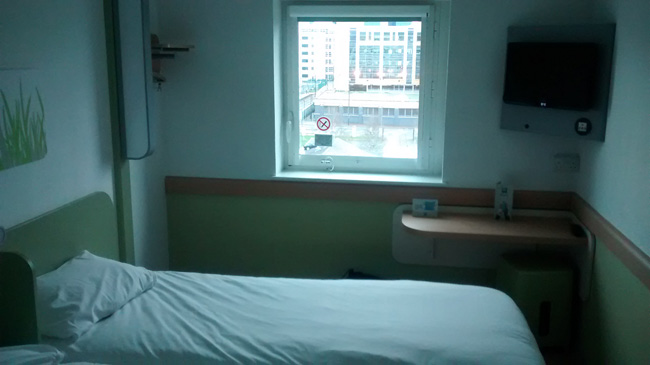
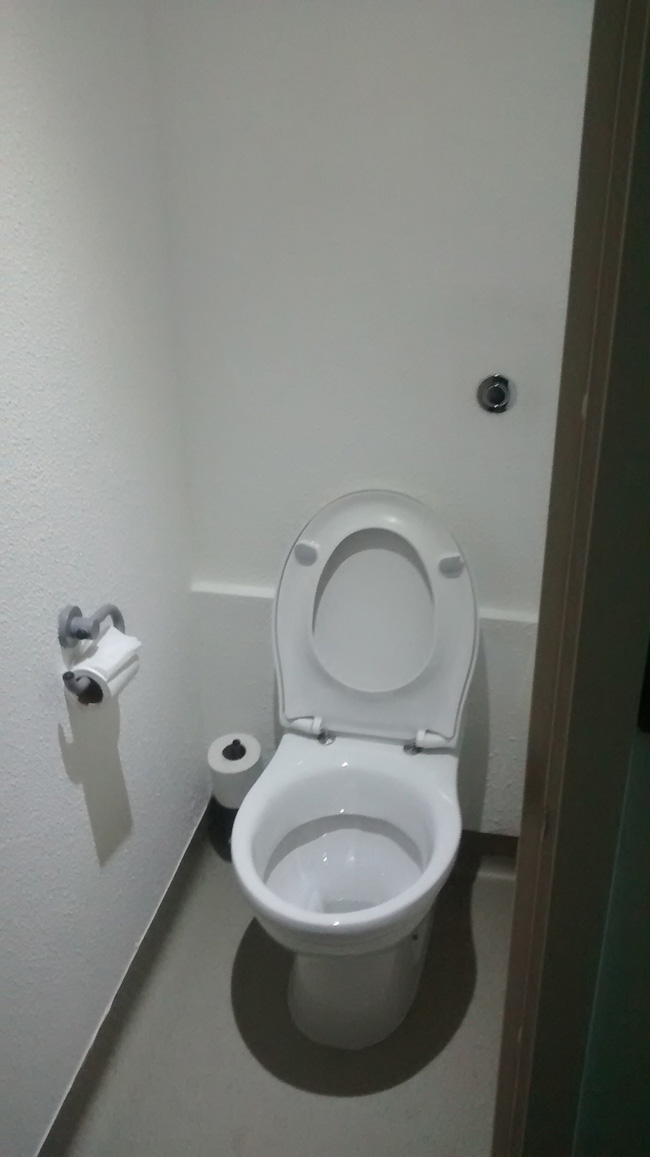
The twin beds were separated by a gap of around three inches with each mattress lying on the same bed frame. The shower was great, however the toilet was located in what appeared to be a cupboard for mops. When you sat down, your elbows almost touched the sides.
We went across the street to a small bar/restaurant. I ended up having a veggy burger and chips. I’m not sure if this is the best thing to eat the night before a marathon, but after three or four days of eating pasta, I was keen on eating something different.

We then started getting everything arranged for the next day so that we could just wake up and leave. The first thing I had to do was pin my number onto my t-shirt.
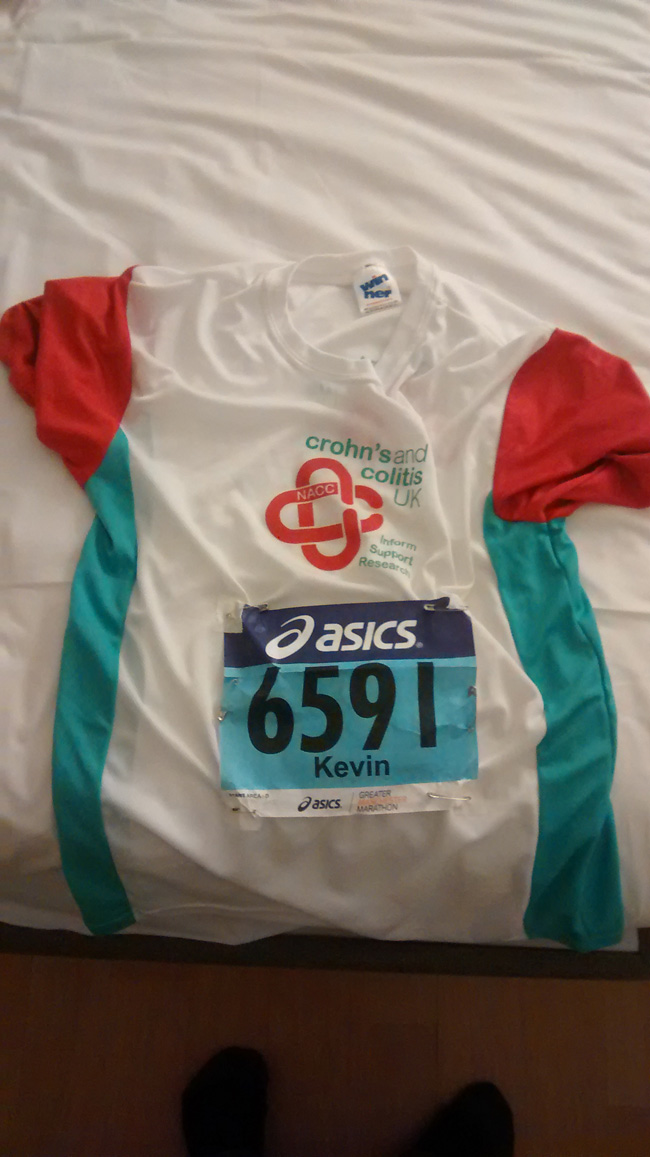
I emptied all of my pre and post marathon drinks and food onto the table. Organised chaos at its best.
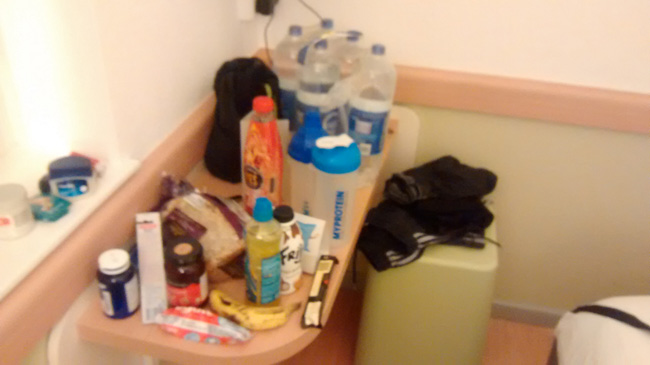
The Greater Manchester Marathon starts at Old Trafford, home to Manchester United. Our hotel was only a couple of streets away, so we did not have to concern ourselves with buses and trains on the day.

Unfortunately, we did not get a good night’s sleep. The air conditioning would not work in our room. So we ended up having to leave a window open. This resulted in a cold breeze blowing through the room’s warm heat, and the additional noise from outside was a real pain.
I am unsure as to whether this was the reason, or whether it was because of something we ate or drank; however neither of us could sleep. We ended up getting around two and a half hours sleep that night. Not exactly good preparation for our first marathon.
The Race
The one benefit to going to sleep at 2:30am and waking up at 5:30am is that you have time to get ready. We had to be at the event village for 8:30am, but we arrived around 8:00am to see what was happening.
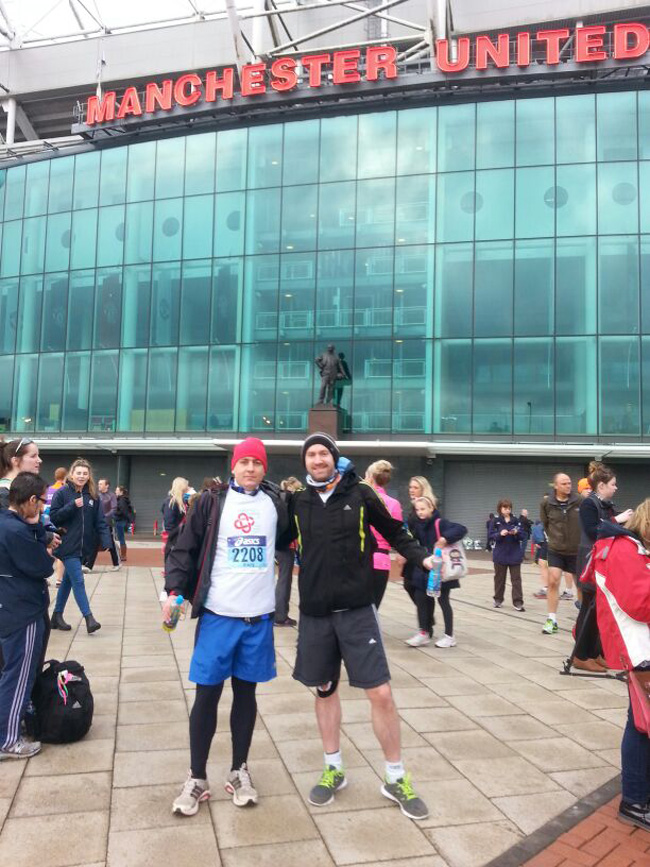
The marathon was very well organised. There was a large tent for everyone to store their bags and belongings. You simply handed your bag over and they stored it using your race number. Various food and drink shops were dotted around the place, including one for vegetarians.
There was an abundance of toilets too, however it did not seem like there were enough before it started as there queues of people outside them. Some had dozens and dozens waiting.
I had not been able to go to the toilet before the event, something which I was actually concerned about beforehand (but thankfully, it was not an issue during the race).
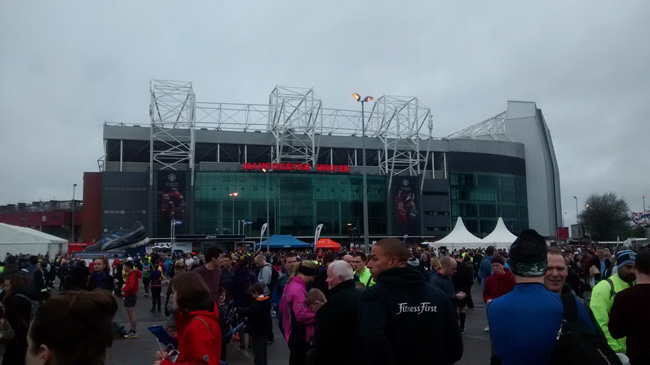
The old idiom goes that you should hope for the best and prepare for the worst. That is how I had tried to prepare. Unfortunately, it was the worst that I had to deal with.
In the first mile, my main focus was on my hamstring. I was conscious of the fact that I had not trained for a month due to pulling it. And it was only three days before that I was limping around my house because of the problem. Thankfully, I never had any major problems with my hamstring during the run. That is something I am grateful for as I was concerned this was an injury I would be dealing with in all my marathons.
I had other problems to face.
From the very start of the race, I struggled to breathe. Perhaps this was caused by me using ibuprofen over the week to reduce the inflammation in my hamstring; something which I should probably avoid due to being an asthmatic. Or perhaps it was due to the high levels of pollution Manchester experienced during the week.
Struggling to breathe is something I do experience from time to time when running, though it only happens during the first mile or two. After that, my lungs are warm and my airways are clear. That didn’t happen in Manchester. I was unable to speak to Barry when running as I could not catch a breath. My inhaler gave me temporary relief, but the problem was back after ten minutes.
We had hoped to run the race together, but we had also discussed what we would do if one of us was struggling. We had both agreed that if someone was injured or could not do it, the other person should just go on. This was the first marathon for both of us and we didn’t want to hold each other back.
Around mile six, I started struggling to keep up with our regular pace and Barry went a little bit ahead. I never caught up :(
This was also the time that I started having pain in my right foot. It was the kind of pain that you feel after walking too much; yet I was feeling this after just six miles, which was strange as I had been running fifty miles a week for months and never had that pain.
I plodded along.
A bigger concern was my temperature. I was burning up badly from around mile two. I put this down to what I was wearing. I had three layers on: a dryfit Nike t-shirt, a lightweight Nike jacket over the top for carrying my energy gels, and my charity t-shirt over the top.
Do you know when people talk about hitting the wall when running the marathon? Well, I hit the wall after six miles. I had very little left. It felt like I was running like a zombie.
A blister that had came up during the early part of the race had popped just before I passed the half marathon point (I later found that Barry was only 56 seconds ahead of me at this stage). At this same point, I took my t-shirt and jacket off and put my t-shirt back on. I then tied the jacket around my waist. Unfortunately, that was not a good solution. Due to the gels in the pockets, the jacket continued to fall down and sway from side to side because of the weight in the pockets. So I put the jacket back on, unzipped. This reduced my temperature a little.
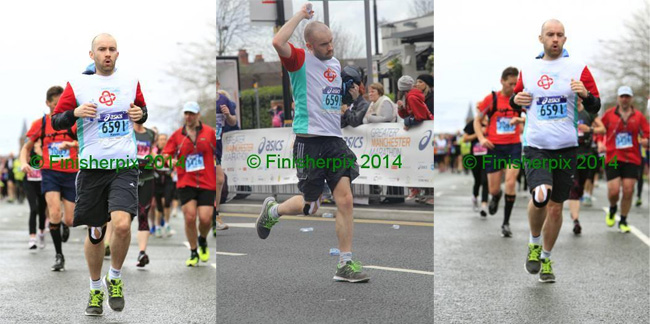
I continued to run around nine minute miles. Around mile fourteen, I noticed the pace runner for a four hour marathon was right behind me. That meant that if I dropped behind him, I would not complete a four hour marathon. Knowing this gave me a small physiological boost to keep going.
The boost was short lived.
I managed to run beside the pace runner around three or four miles. By this point, I was in a bad way. I was sweating profusely and my heart rate was very high. I was genuinely getting concerned for my own health. I am someone who has gotten injured multiple times in the past by not listening to my body and going on regardless; so for me to get concerned like this illustrates how bad it was.
I started feeling a bit dizzy and felt my eyes close at one point as if I was going to feint. So I moved to the left hand side of the road. Then I stopped.
I cannot fully describe the disappointment and frustration I felt when I did this. I was really ashamed at myself and angry at myself for not going on. The truth is that I could not go on. I physically could not go on.
I proceeded to walk and jog the next two or three miles. Watching the four hour pacer jog away into the distance was disheartening as I knew that I had failed my challenge of running the marathon in four miles.
During this time, I was not even sure if I would finish, however my breathing had come back under control, so I could breathe normally. The problem is that the pain in my right foot was much more severe. Therefore, even though my lungs felt much better, I could not physically run fast as the pain in my foot was so bad. Technically, if the pain in the foot was not there, I could have finished under four hours (well, that’s my theory!).
After walking and jogging, I started running at a slow pace of around twelve to thirteen minute miles (this was around mile twenty). I was still running in empty, yet I really enjoyed this part of the race. During most of the race, I had a high temperature and struggled to breathe. It was exhausting. And even though I had a lot of my pain in my foot, I could enjoy the race in the way I should have from the start.
At around twenty four miles, I saw a lady who was around sixty five years old run past me. I won’t lie to you; that annoyed me!!
At around twenty five and a half miles, I saw the pace runner for a 4:15 hour marathon. This spurred me on during the last half mile and during the final few hundred metres, I sprinted through the pain and overtook everyone there.
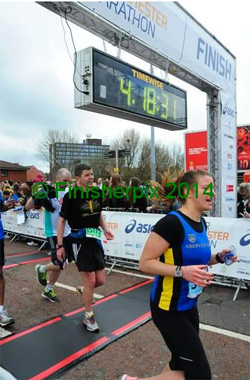
I finished in 4:15:01.
I thought crossing the finishing line would feel amazing, but I just felt frustrated about everything that happened. We had been on course to run the marathon in between 3:40 or 3:50; perhaps even quicker. I had fell very short of that target.
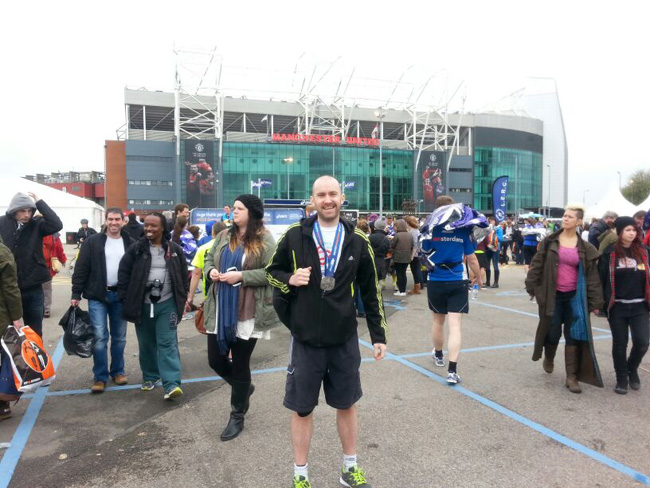
Barry finished twenty minutes before me in 3:54:40. It was a great effort by him. Like myself, he had very little sleep the night before. He was also having problems with his hips over the last few weeks and had extremely tight calves during the latter half of the race.
He also had to stop and jog slower, but managed to keep it going and finished the race in under four hours.
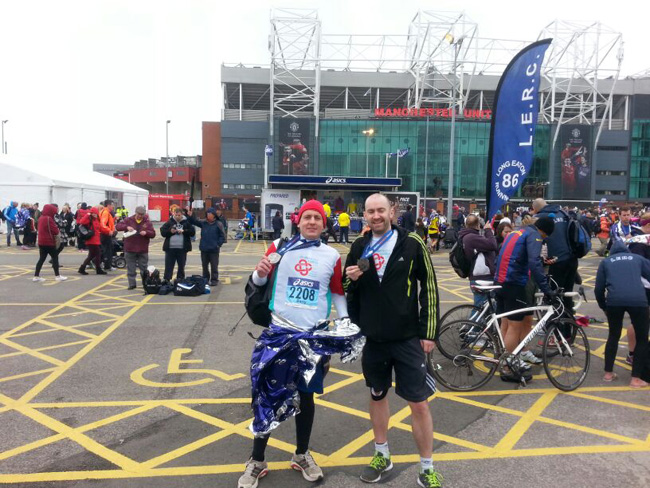
I experienced a whole new level of exhaustion after the race. I have exercised all my life and had sparring sessions in Taekwondo that were so hard that I would just lean against the wall to save energy; however this was a whole new level. It took an hour or so before I started feeling normal again.
Throughout the whole race, the people in Manchester were fantastic. The vast majority of the race had people standing by the sides supporting you. People would shout things such as “Come on Kevin” and “Keep going Kevin, you can do it” (note: everyone’s names are underneath their number). As cheesy as that sounds, when you are close to mentally breaking, it helps. It helps a lot.
The people who were watching were also offering sweets during the race and kids would stick out their hands for high fives. I have no doubt that this happens at every marathon, but it was the first time I had experienced it. It was little things like that which made the event enjoyable (despite my frustrations).
It was also great to see what other people were doing for the marathon. In addition to soldiers doing the marathons with heavy backpacks and people running in costumes such as beer bottles, I saw a guy at the very start doing the race on a pogo stick. The man, Jack Sexty, became the first person to complete a marathon on a pogo stick. He finished the race in sixteen hours. Unbelievable!
Post Result Pain
Following the marathon, I couldn’t walk properly. I was unable to put pressure on my right foot.
I managed to hobble into Manchester city centre to meet my friends Dave and Greg. It became clear that the pain was getting worse as the night went on. Thankfully, I was only out for a few hours and by 8:20pm, I had returned to the hotel.
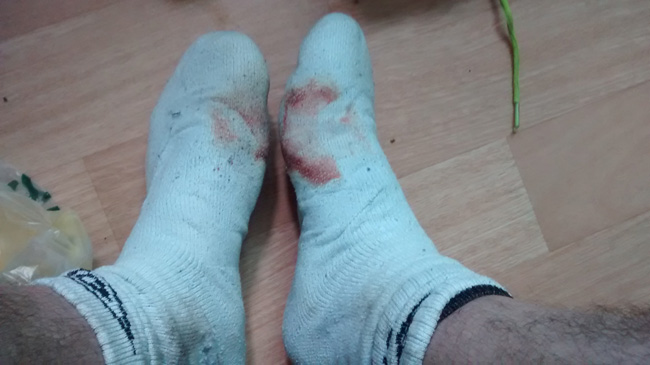
By around 10pm, I was in severe pain. It was so bad I had to crawl to the bathroom on my ass just to pee! I then spent the whole night squirming in pain due to the throbbing pain in my foot. It was also spasming, and I had no painkillers to relieve the pain.
If my awful hotel had a phone to call reception, I would have called them and asked them to phone an ambulance for me. I know that sounds a bit extreme for a foot injury, however the sharp pain I was experiencing was awful. It felt as bad as the pain I had experienced years ago with my neck injury.
I eventually collapsed through exhaustion and got a couple of hours of sleep. The pain was a little less severe in the morning, but I still could not walk properly. Barry had to help me out of the car at one point and it took me about four times as long to walk anywhere.
Following the marathon, I had no real appetite. This was no different in the morning, however I forced myself to eat something as I knew that my body needed energy.

We then made our journey back to Scotland. Due to traffic roadworks and an accident, Google Maps rerouted us three times, which resulted in us driving about fifteen miles, getting sent back down the same way and then going back. Thanks Google.
It was not long before we were back into the land of Nessie.
When we stopped at Gretna services, Barry had to physically help me get out the car as I couldn’t do it on my own. I was like an old man!
Barry dropped me off at my local hospital, however they advised that the waiting time was at least four hours. This was around 5:30pm. After very little sleep, and running twenty six point two miles on an empty tank, I decided going home was the best option. I ended up sleeping for around ten hours or so.
I got up this morning and headed down to the hospital. The nurse quickly diagnosed that I have cellulitis: a severe inflammation of the skin that is usually caused by cuts, blisters, burns or bites.

Cellulitis causes severe swelling and fever; which explains why I was burning up during the first twenty miles of the race
I was clearly suffering from fever after the race after the race. I said to Barry how cold it was a few times and he looked at me as if I was crazy and told me it was warm.
I am still unsure how I caught it and when. The nurse believes that the cause of the issue is my running shoe. I am not sure. Looking back, I felt a bit crappy all day on Saturday. At the time, I put this down to all the food and drink we had to eat to carb load. And despite getting much sleep on Friday night, I could not get to sleep the following night. So I may have been suffering from cellulitis on the day before.
I am on antibiotics for a week to clear the inflammation and remove any bacteria that is there. I should then be ok to start training again (hopefully!). Once the problem has healed, I am going to head into a proper running shop in Glasgow and have myself fitted properly for a good pair of running trainers. Perhaps the wrong running shoe is not what caused cellulitis, though my black toes and frequent blisters highlight that something is wrong. Therefore, it is time to change them.
The diagnosis of cellulitis explains most of the problems I experienced during the race such as my high temperature and my painful right foot. Running with unsuitable footwear would explain why I got blisters.
I am unsure as to whether ibuprofen was what caused me breathing difficulties. It was my immediate thought during and after the race, since people who suffer from asthma are known to experience problems with it; however it may have been caused by the fever I had.
Ideally, I should take ibuprofen before a run so I can see whether it does affect me greatly. I’ll probably play it safe with my next marathon in Belfast and not use it, just to be sure that it isn’t a factor.
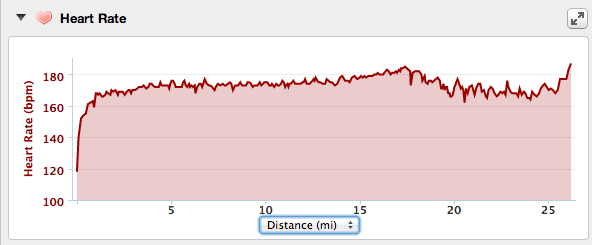
I purchased the soft strap Garmin heart rate monitor last week so that I can start monitoring my heart rate in big events and in interval training. The graph above illustrates how high my heart rate was during the race. It was never at a comfortable level.
As I am sure you are aware, marathons put a lot of stress on your heart. My friend Kenny, who is a doctor, said that you run the risk of arrhythmia if you put your heart under that level of stress. This can increase the risk of a heart attack.
I am going to continue to monitor my heart rate. I was never interested in monitoring my heart rate on my slower runs, however I want to get a better understanding of what my heart rate is in all situations. That will help me to slow down or stop if my heart rate does get too high.
The Manchester Marathon was my first race using the heart rate monitor; therefore, I was not fully aware of the risk I was taking. The only other time I monitored my heart during a run, I was around 160 beats per minute; and I was running much faster. In contrast, my overall average heart rate during the Manchester marathon was 172 bears per minute.
Final Thoughts
All in all, I’m still incredibly disappointed by my result as I was about thirty minutes slower than I aimed for. Anything that could go wrong for me did go wrong.
I always wanted my first marathon to be a good one, so I am disappointed that I did not get a good time. I am glad that I managed to finish the race though. During the latter half of the race I saw a lot of people on the sidelines with pulled hamstrings, calves etc. I can only empathise with people who had to pull out because of something like that as I know the how hard it was for me; and my injury never stopped me altogether. If I had pulled my hamstring or calf, I would have struggled to even walk.
The diagnosis of cellulitis alleviates some of my own frustrations as I know I have the ability to do better in four weeks time in Belfast. One month ago we did our twenty mile run at 8:25 minute miles. When I did that run, I felt like I could do another six miles at the same pace. Even if I had dropped that pace to nine minutes per mile over the last six miles, I would have still have got a time of 3 hours and forty four minutes.
Despite the bad result and pain afterwards, I feel it was a great experience.
For the first twenty four hours after the marathon, the thought of doing another one in four weeks was the last thing on my mind. However, as my fatigue fades, and my foot gets better, I’m starting to look forward to the next one on 5th May. We made a lot of silly little mistakes in our preparation, and I had a bit of bad luck along the way, but I guess that is part and parcel with your first race.
Over the next four weeks I need to ensure my foot gets better, buy suitable running trainers, and make sure I get out there and keep my fitness up. My marathon journey, after all, has only just begun.
Finally, thanks to everyone who donated to our JustGiving page at http://www.justgiving.com/crohns4marathonchallenge.
The donations we have received from friends and families so far is unbelievable. I cannot thank you all enough.
For any of you thinking of doing a race, my recommendation is to get motivated and do it. It does not matter if it is a 10K, half marathon, or a full marathon. You will face trials and tribulations along the way; but it’s worth it. It is a good excuse to get off your ass and get healthier and a great way to raise money for charity.
I truly believe anyone can do it. At the end of last July (i.e. nine months ago), I went out for my first run after returning from South America. I ran about a mile and a half and then had to stop and walk the rest as my fitness was so bad. A few weeks later I had upped my miles to a half marathon. You just need to persevere and make running a habit.
I will give you all an update on my challenge next month. Belfast is apparently a tougher marathon, but I should hopefully break the four hour mark.
Thanks for reading,
Kevin
Nice. Rowing is great for general fitness.
I am hoping that my neck is better at the end of the year so that I can get back into martial arts. I will always enjoy running, though I miss the fun of doing martial arts classes etc.
@Andrew: Evolution Running is something for running in general and great advise. Chi Running saved my butt, I believe, during my 100k run on Mr. Olympus in Greece last summer (www.omt100.com), specifically the uphill running technique. But you wouldn’t use that on regular uphill parts. But still, all in all these would be the 2 video courses or books, respectively, that I’d whole heartedly suggest to read foe every one in terms of running economy and running injury free.
@Kevin: Can it be that your two posts on marathon running are the ones with the most comments so far? Would be interesting, especially since running isn’t exactly the main subject of your blog :D
BTW: Using Google Chrome the ‘reply’ link under an answer doesn’t seem to work. It always gives me only the option of creating a new reply, rather than one within a comment thread.
Sounds like a good plan Kevin, I ended up buying a Concept2 rower to use at home and also bought the digital rowing – RowPro software for online racing / training which is all great fun and motivating… although I’ve been guilty of a long lay off and need to get back on the iron horse :-)
I’ve always use the Vivo barefoot shoes and have several pairs so I can use them for casual and even work use, all of which has helped my heel woes no end.
@David that’s a great track record, I think I have one of those books so might give it a re-read and try and be a bit more disciplined this time around :-)
Cheers, Andrew
I will need to check that out. My hamstring injury is 100% my fault. I ran too fast and then when I felt a niggle, I kept on running. Then I did another twenty miles or so before stopping. And since then I have just been trying to get it back to normal. If I can get through the Belfast and Edinburgh marathons, then I have seven weeks until the next one. That will give it time to heal properly. :)
Yeah kettle bells are great. I used to use them all the time at Taekwondo. I don’t have kettle bells just now, though I have dumbbells, a pull out bar etc.
My friend Kevin used to wear Fibrams all the time. He got a lot of strange looks when we were in Vietnam. haha.
@Kevin: thank God, I have been injury free over the 4 years I have been running long and ultra long distances (incl. mountains).
I believe it’s all a matter of running technique. Just like one wouldn’t go out to play golf without learning the right technique, or swimming, also correct (= pain and injury free) running needs and has its technique. I am not saying I am a pro in this but what has helped me, I believe, tremendously was studying both ‘Evolution Running’ by Joe Friel as well as ‘Chi Running’ by Danny Dryer. I believe that those two can be able to eliminate 99% of your injury risk (leaving aside injury caused by too much training).
Regards,
David
Also kettle bell swings are awesome for fitness and a full body workout!
I love barefoot shoes, like the Fibrams. Indeed one has to get used to them slowly, otherwise severe pain in the calves is sure. If they didn’t look that akward I’d wear them much more often and in public :)
Running is ridiculous for running. I haven’t met any runner yet who hasn’t got some sort of niggling injury.
I popped my calf muscle around five years ago (actually heard it pop!), so I know what you mean about minimal trainers. Trainers with high heels (e.g. nike shox) raise your calf muscle up so you don’t need to stretch it too much. This can actually be detrimental to recovery as it is good to stretch the muscle out. Though there is obviously a fine line. I have minimal trainers and I do feel pain in my calf after running long distances in them.
Rowing machines are good, though I’d have to go down to the gym for that (25 minute walk away). For ease, I’ll probably use my gym. I built a gym in my garden that has one punch bag and one long heavy bag for kicking. I can punch and do some basic sit ups etc until I am tired. Well, that’s the plan. After going to the running shop today, we went to the Pizza Hut buffet haha :)
Bit of a worry on the hamstring but hopefully it will settle, physio might be able to help / advise and a good one might be able to go some gait analysis. I’ve never been able to get very into running as I always seem to get injured pretty quickly…
The problem I had was that I got plantar fasciitis that I couldn’t get rid of for 2 years, I then went against the grain and got some barefoot shoes which fixed the problem really quickly and I’ve lived in them ever since… problem I have now is that the barefoots tend to overstress my calves and I’ve torn my calf a few times – too much too soon and I need to learn some patience but I always get carried away when I do get out running! lol
Anyhoo… what I did find was the very regular use of a rowing machine was absolutely great for fitness and as a non impact activity is a really good intense exercise and I’d recommend it for endurance building / maintenance – nice steady 20 – 30 mins on a rower will do the trick nicely and should keep your oxygen blood levels up for the next few weeks ;-)
Yeah fingers crossed.
Next one is in Belfast. It’s quite a hilly marathon (so I am led to believe), but I think the main incline is spaced out over a few miles.
Was on the treadmill briefly today for them to look at my running stride and my hamstring was in pain. So I am icing it just now. Will hopefully feel better over the next week or so.
I won’t be able to run before the marathon. My idea is to go out to my gym and hit the punch bag for 20-30 minutes and get my heart rate going. I think my endurance will be fine, though I expect I will be tired at first because I haven’t been running. Bizarrely, the only real run I have done over the last month was for 26.2 miles haha.
Kevin
Where’s the next one at Kevin?
Hopefully you’ll get a much smoother run this time around :-)
Andrew
Thanks Andrew.
I’ve not been back to the physio since the marathon. I may go back once or twice before the next one (which is 13 days away).
Picked up some new running trainers today, so hopefully I will be like Speedy Gonzalez in my next run :)
Kevin
Fantastic job completing the marathon there Kevin, any endurance event is tough enough even under ideal conditions but even more so with the problems you faced along the way.
Serious kudos for grinding through that one and getting to the end… it will be interesting to see if the sports massage manages to outdo the marathon on the pain scale mind… ;-)
Thanks for the advice. Yeah I need to get out and walk. I’ve not had a chance over the last week as I’ve been swamped with work. I should try and get out tomorrow and walk a couple of miles.
I’ve been icing my hamstring four or five times a day (maybe more!). Been taking iboprofen too. Going to try and see the physio at some point this week too and see if he can give me a sports massage.
:)
Kevin
Great news about the foot, Kevin! Recovery is important, but active recovery is even more important. Slow tempo runs, or even just walking, is best. Keep that hamstring moving and quit icing it! You want heat and your want mobility work. What kind of mobility stuff are you doing now? Feel free to email me a reply if you don’t want to clog up your comments section. ;)
Oh, and I found your blog via one of your WP articles about plugins. Good stuff! Run happy and enjoy life!
Thanks for leaving a comment Meghan.
I was at the doctors today and they said that the cellulitis is away. I was concerned it was still there as when I went for a short run yesterday, I had a lot of pain in my foot. Though the doctor said this is just inflammation from when it did occur.
She noted that I must have caught it at least a few days before the marathon. So it sounds like it was just bad timing on my end as I didn’t even run in the week before the marathon because my hamstring was so bad.
Good advice about the gels. I bought a small holder for my waist (like a bumbag), though it was uncomfortable carrying it with ten gels. Though what I might do this time is just take five gels with me and then stock up on others as I go round. I didn’t use ten last time anyway. Think I used seven or eight during the whole marathon. So I could maybe run with only four or five and then pick up a few more when I’m running.
haha yeah I didn’t do the carb loading right. Though by the time Saturday came around, I was sick of pasta. Plus I had drank enough lucozade that day so I didn’t actually need many more carbs. I’ll probably just carb up the night before for Belfast.
I’m looking forward to May, though my hamstring is still giving me a lot of bother. I ran six miles on Monday afternoon and my hamstring was in a bad way the next day (limping etc). I am not sure if I’ll be able to run again before the marathon. Though from what I’ve read, at this point, recovery is more important for me than getting runs in.
Kevin
Few things:
1. Congrats on the marathon. I hate that you feel frustrated with your results… you have to understand the level of awesomeness you attained with not only your time, but also your willingness to carry on through the pain (stubbornness?).
2. Your socks, man. Get better socks!!!!!!!!!!!!! Those suckers look like cotton. No wonder your got blisters… I bet the bacteria was crawling all over those socks or the inside of your shoes and the sweat that builds up in the cotton socks gives bacteria its favorite environment: warm and moist. I really like Swiftwick and CEP compression socks. No more blisters. And definitely no cellulitis. Good call on the hospital!
3. Find a better way to carry your gels. I’m sure you realize this by now. Keep as few layers on you as possible… too much heat is worse than being cold. ;) And you’re trucking at your pace, so you are guaranteed to be plenty warm with one base layer and maybe something over top if you are running in cold weather.
4. Great write up… wish I could be as fast as you, haha.
5. I think it is HILARIOUS that you carbed up with a bunch of pasta then ate a veggie burger & fries before a marathon… when you wore a Crohn’s/Colitis race shirt. My gut quivers at the thought. ;) (PS- only carb up right before your races, not for a whole week, and definitely not if you haven’t already been carb-adapted for your previous long runs. Race the way you train, just faster.)
6. (Oh boy, I got carried away!) Good luck in May!!!!
Thanks for the kind words Noble :)
I think it’s great that you push yourself past your limits for a cause that you are passionate about. That’s what life is all about. It’s not about the money that we make or the material things that we acquire. It’s about those epic moments when we feel that awesome feeling of accomplishment that keeps us going.
Salute
Thanks Noble.
I went out for my first run today, eight days after the marathon. Unfortunately, my quad/hamstring are still in a bad way. My foot was in a lot of pain too. Going to the doctor tomorrow to get another week of antibiotics as my foot has clearly not healed yet.
I will just take things as they come. The next marathon is less than three weeks away. Though I feel that recovery might be more important than training at this stage.
Kevin
I think that what you did is awesome! Congratulations on achieving your goal. It is truly an inspiration. I’m glad that you’re doing better. Keep up the great work.
Cheers
Thanks David.
Admittedly, I don’t really know too much about carb loading. I did it for three days and just felt bloated. And on the day before the race I felt like crap (though that could have been caused by the cellulitis).
One things I have discussed with my friend is that we ran eighteen and twenty mile runs without doing it. All we did was ensure we ate pasta or rice the night before. Yet, on those runs, I felt great. I felt good enough to run the full twenty six.
I need to look into it before Belfast in three weeks. I’d prefer to just eat healthy and make sure I have pasta the day or so before. Though I don’t think getting one kilogram of carbs for three days is necessary. I’m sure I’ll find out soon enough.
I don’t eat too much crap, partially because I’m vegetarian. It helps me cut out a lot of the bad foods that others eat.
I’d definitely love to do a trail hike. The one thing that has been annoying about training for these marathons is that we have not had a chance to do any hill walking. I love going for a hill walk at the weekend.
Belfast has quite a steep elevation at one point. So I’m keen to fit in a hill walk or two before that.
:)
Kevin
Hey Kevin,
Despite all the fustration and the unexpected turn of events: you are now a marathon finisher. Let’s leave aside the fact for the moment that probably you shouldn’t have run in the first place under these conditions: the fact that you did it under these conditions makes your achievement even bigger, not smaller.
Don’t be too sad about it. There will be many more marathons to come and each one will have it’s new challenges, ups and downs. If you have the chance to do a trail marathon, I can totally recommend that, even more so in Scotland where you have beautiful nature.
Regarding carbo loading etc: I am not too big of a fan anymore. Yes, much of the scientific literature tells you to do it, but that’s mostly because over the years many people have just said and written about what they heard. You’ll find a growing number of scientific articles that tell you that carbo loading is not really necessary. They will tell you on the other hand to run in an aerobic state where you mostly use fat rather then glycogen. You only store enough glycogen for about 2 hours or so, and replenshing doesn’t happen fast enough during the race to fill it up again. Fat, on the other side, is available more than enough, even in lean people. One could go, theoretically, hundreds and hundreds of miles only on the fat reserves one stores. But for that you must not cross that threshold where you start burning glycogen rather than fat.
I am not a scientist and I also just repeat what I read. So it might be wrong :) But: as a fan of Paleo in 2010, after my first marathon, I bought the book “Paleo Diet for Athletes”, authored by Joe Friel and Prof. Loren Cordain, two people known in their fields of athletics and Paleo, respectively. It is a great read (at least I think so), and together with training I could run 3:31 in April 2011, at a marathon here in Greece that is defeinitely not flat.
Maybe worth a try. Especially since I consider all those gels and sports drinks a big pile of artifical junk. Since I try to consume natural and organic products before and after races I feel so much better, in the stomach and in my muscles, before, during and after the race.
Congratulations again, and good success with your next race early May!
David
Sounds brutal!
I couldn’t imagine running that far for that long, let alone in those conditions.
Good luck with the next one.
Joe
Sorry to hear that Asif. I’m thankful that I did not break any bones. That sounds like it would be a pain to walk around for months.
I see no reason why you cannot do it. The key is to stay injury free (for the most part) :)
Just one word. Respect
I love the way you have documented it, just like a Novel.
and I think you did really well.
At least you ran.
I broke the femur bone of my left leg by falling in the bathroom
I had to stay away from the gym for over a year and now that I am back,
I usually feel pain after just one mile of run.
However, I am optimistic and hope I’ll run a Marathon someday.