

It can be interesting talking about websites and blogging with those who do not work online. Those who do not work online for a living see the internet differently; so I always enjoy hearing their perspective.
Me and my friends are currently training for our first marathons. Whilst doing a ten mile run this morning with my friend Barry, he mentioned that a lot of the running articles he has been reading recently seem like they are just copies of other articles.
I explained to him that this is unfortunately common place across the web due to content farms. Content farm websites are notorious for paying terrible rates to writers. It is not uncommon for writers to be paid less than $5 per article. As the saying goes: “If you pay peanuts, you get monkeys”.

With such an emphasis on quantity over quality, writers for content farms are notorious for cutting corners (you can’t really blame them when the rates are so bad!). Some writers copy published articles from others and then reword parts of it so plagiarism is not so obvious. Others take an easier route and use article spinning software.
Google’s Panda algorithm update in 2011 hurt content farms badly, however there are still millions of poorly written articles online that have good rankings in the search engines. This is a problem if you are searching for good advice.
In a world where anyone can publish an article online, who can you trust?
I believe that the advice from people who are passionate about their subject carries more weight. When someone truly has a love for something, they will research the topic and they ensure that what they say is true.
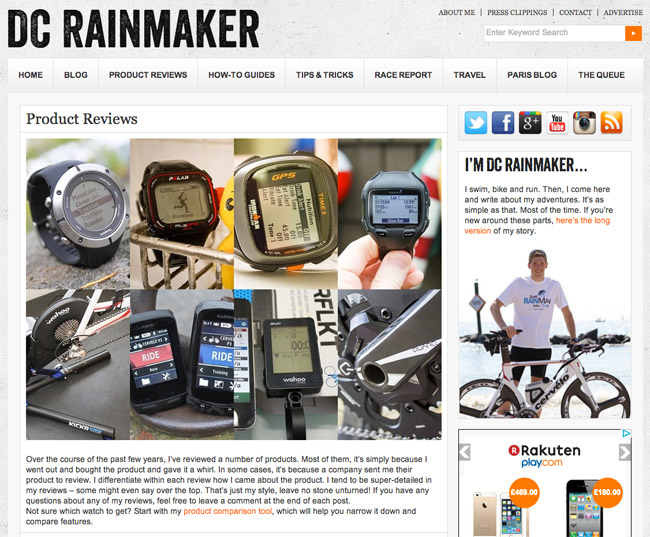
That is why I believe that, in general, advice from personal bloggers is more reliable than content published on large websites. Take the world of technology for runners, for example. The undisputed king of running tech is DC Rainmaker. Each product review is several thousand words long. He tests every aspect of a product. It is easy to see that he truly loves what he does.
The difference between his reviews and those on established running and sports websites are night and day. Whereas he spends weeks reviewing a product, most running websites write a few hundred words at best. Most of them tend to focus on top ten lists and simply reword the press release that was published by the company. Few of them actually review the product that they are actually reviewing!
It is important for me to clarify that I am not suggesting that those who are write for others do not take a pride in their work. I am someone who blogs for himself and blogs for others. I love what I do and always strive to give clients the same attention and detail that I do on my own blog (if not more).
However, us freelance bloggers sometimes have our hands tied behind our backs. We need to dance to the tune of our clients.
I am quite lucky that I work with some great WordPress related blogs such as WP Hub, WP Squared and Elegant Themes. Unfortunately, not all clients are this good to work for.
A few months ago I did some work for a large WordPress website (I won’t say which) who had a policy of not linking to other websites. I was only permitted to link to their own websites.
As a result of this, they murdered my first few articles by stripping all references to other websites. I had included links to many useful resources that would have truly helped others (note: I had no connection to any of the websites in question – they were just useful resources). My pleas to leave these references in the article fell on deaf ears. All they cared about was SEO, which meant that the quality of my articles were greatly reduced.
About a week later, I parted ways with the client due to how difficult it was to work with them. By removing links to other websites and making the articles less useful to visitors, I was hurting my reputation and shortchanging visitors.
Bear this in mind the next time you read a poor article on a high traffic website. It might not be the fault of the author. They might just be following orders.
Most personal bloggers give an honest view on topics when they write about them. I say “most”, as there is always going to be bloggers who will write anything if it means making visitors click on a link. However, taking everything into consideration, I feel strongly that the opinions of personal bloggers carry more weight than those who write for others.
What’s your view on this issue? Are you more willing to trust someone’s advice if the the article was published on their own blog?
Kevin
Hi David,
First one is in Manchester on 6th April. Then Belfast on 5th May and Edinburgh on 25th May. Finally, there is the marathon in Wales in mid July, however we haven’t signed up to that one yet.
Don’t know if I fancy ultra running though. Ideally, if my neck is better after physio, I can throw myself back into martial arts after the last marathon :)
Kevin
Great to hear that you’re about to run your first marathon! I’m a very passionate ultra runner myself, after running my first street marathon 3 years ago. Now I am more into trail and alpine running, because of the great surrounding while running :)
When is it gonna be, and which marathon?
Regards from Greece,
David
One issue I face with niche ‘keyword rich’ websites is, they write an article of 1000 words or more, but effectively there is no takeaway for the readers. It just states and repeats the obvious. I think, that’s because they write for the search engines (which are the primary source of traffic for them) instead of writing for the readers. But personal blogs have real readers following each and every post of theirs, hence they are more careful and offer useful content in an interesting/conversational tone.
Hi Joni,
I can offer direct support for $50 an hour or support through RiseForums for $97 per year.
Kevin
I was wondering if you could help me with feedburner – i saw your article on it. Ill send you a fee through paypal!!! please?! the problem is my blog would update on the “Favorite Blog” reader list that you find on blogs. Do you have any clue what I can do to get it update? It is stuck on my last blog a week ago!! ????
thanks!
Shorter articles are still the bread and butter of entertainment websites. If you check the articles that are being shared on Facebook, some of them do not even have 100 words. They simply list images or videos.
In a world where people can’t be bothered writing good articles, guys like DC Rainmaker stand out. And that is to his credit.
I definitely feel that quality is more important than length. Adding in filler does not help readers. If something can be said in 500 words rather than 2,000; then it is better to say it in 500.
:)
Kevin, although I agree in principle that a personal opinion can have much greater authority I wonder at how sites such as DC Rainmaker can get away with such lengthy pieces, since the prevailing attitude on the ‘Net is still “shorter is better”.
We’re constantly being told that we have to capture our visitors within a few seconds or they will vanish. We are relentless in our pursuit of making our sites faster loading. We are given the Gospel that brevity is the soul of wit.
Yet a few sites like Rainmaker and one of my favorites, Steve Pavlina’s blog, consistently post what amount to full-length novels yet have loads of loyal readers.
Is it quality, regardless of the length? I think it is. Is it only the truly hard-core that will hang around long enough to read that article? It seems to be.
Thanks for this post – it’s great food for thought.