

The act of blocking advertisements online is not new. People have been using ad-blocking scripts for years to stop advertisements being displayed when they browse the web. The question is: Is this ethical?
The BBC posed this question last week in an article entitled “Is it ethical to block adverts online?“.
The article spoke about the popularity of Adblock Plus; an ad-blocking script that has been downloaded over 250 million times and apparently boasts an active membership of 60 million users. The script allows users to disable video ads on YouTube, Facebook ads, pop ups, flash ads and more. It also disables tracking, malware domains and social media buttons.
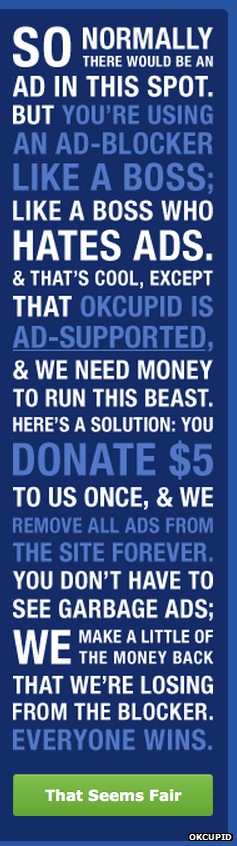
As I am sure you are aware, advertising is the main source of revenue for the majority of websites online. Without advertising, most websites could not exist. So it is not surprising that many websites are fighting back against this. The BBC article spoke about how the free dating website OkCupid is fighting fire with fire. When someone visits their website using an ad blocking script, they will see a large banner that explains that their website is ad-supported. It goes onto advise visitors that if they simply pay $5, they can use their website free forever.
The Majority of Internet Users Believe Blocking Ads is OK
Let me just clarify one thing before we move on. I am self-employed through the internet. I make money from websites I develop and from writing articles for other website owners. Therefore, blocking ads is something that threatens my livelihood. I am, however, also an internet user. I have been using the internet actively since 1996 and I understand why many people want to block ads.
No one likes obtrusive ads. I hate websites that start video ads automatically or cram a dozen advertisements around an article that is only a few hundred words long. There is a genuine concern amongst all internet users about having their computer infected due to a malicious script, however I am of the opinion that most websites do not overwhelm visitors with advertisements. Malicious advertisements tend to be used more on porn websites, poor quality content websites and illegal download websites. So if you are having a lot of problems with viruses, you may want to review the type of content you are viewing online (or the type of content others are viewing through your computer e.g. friend, children, spouse etc).
The article on BBC did not tell me anything I did not already know. I have participated in discussions regarding this issue on webmaster forums many times over the years. What did shock me was the view of the general public.There are currently 602 comments on the article and the vast majority of commenters strongly believe that blocking ads is ethical and just. Some of the reasons given are a bit silly.
There were dozens of people who said that they block advertisements in order to reduce bandwidth. I appreciate that this may be a concern with people with terrible internet connections, though it is unlikely to be a major issue for anyone within the UK.
What most internet users seem to be unaware of is just how expensive it can be to host a website online. They are unaware that their own presence on a website costs a website money; particularly if the website hosts their own videos. This is not a small cost. Large websites spend thousands of dollars on hosting every month and displaying advertisements is the only thing that allows them to afford those costs.
The General Public Needs to Be Educated
I believe the general public need to be educated better about how websites make money. They need to be taught that:
- Hosting a website can be expensive.
- Paying authors to write content can be expensive.
- Ads support websites and allow content to be published free.
Despite this, as an internet user, I feel that everyone has the right to disable ads. I truly do. However, I also believe that website owners have the right to stop anyone who is using an ad-blocking script from viewing their website. Content costs money to produce and any visitor who blocks ads is costing the website owner money by increasing bandwidth but not supporting the website through ads.
The irony is that many websites use obtrusive ads in the first place because visitors became ad-blind. This encouraged many website owners to use more and more extreme measures of advertising products. We have seen this happen in large websites. For example, IMDB frequently places huge image background ads around their website to promote films.
Here’s the thing (Yes…there is always a thing!). Websites need to generate money. We all have bills to pay and mouths to feed. Certain types of websites can make money without advertising. For example, online shops profit from selling goods directly to customers whilst premium websites charge a fee to view content or participate (such as Rise Forums). The majority of websites can only be supported through ads.
If you block ads, the website’s income drops. How do you think website owners are going to respond to this?
I think it is going to go one of two ways. Websites may follow OkCupid’s lead, block people who do not want to see their advertisements and ask for a donation. The more likely alternative is for websites to deliver advertisements in an alternative format. If you find advertisements obtrusive just now, just wait until the articles you are reading have advertisement links inserted in every other paragraph. A lot of websites actually use product placement technique already and it is very difficult for ad-blocking scripts to stop.
Is Blocking Ads Ethical?
For those of you who do block ads, here is an analogy for you to consider:
An internet user who blocks ads is like a person who has sneaked into a cinema to watch a film free. The cinema obviously has overheads such as electricity, staff, equipment, renting the movie etc. If the cinema has a few hundred seats and only one person has sneaked into watch a film, I do not think that anyone would consider this to be a big problem. Now consider a cinema in which 50% of the people watching films have not paid for their seat. Ask yourself this:
- What do you think will happen to that cinema?
- Do you think the cinema would have the right to stop you using their cinema free?
You may think that I am being a little over the top with my analogy. The truth is that many websites are actually losing more than 50% of their revenue. Earlier this year the gaming website Destructoid spoke about this issue and noted that many websites have closed down because of this (they noted that some websites have seen a block rate of 75%!!). That has resulted in thousands of people losing their jobs because of people blocking ads.
Is blocking ads ethically wrong? I think it is, though there is no doubt that it is affecting people’s livelihoods. Just as we have seen a rise in the use of ad blockers, we may see a rise in the number of websites who are blocking those who do use ad-blockers. There are two sides to every story. The problem is that internet users have not heard the reasons why advertising is necessary. Therefore, we need to do more to educate them.
What’s your view on this issue? I’d love to hear your opinion.
Thanks for reading,
Kevin
While I’m several years late to this article, I agree, your analogy is incorrect.
It’s more like a cinema was showing a movie for free and everyone came 15 minutes late after all the pre-roll ads had finished.
In what way has this anything to do with emotion?
Your analogy of someone downloading a film is flawed. A website owner doesn’t want someone visiting their website if they block ads. That’s the whole point.
If tens of thousands of people visit a website every day, hosting costs increase. And if those people are blocking ads, you have a situation in which costs are going up and revenue is not going up.
If you block ads on a website and they ban you, what have they lost? They haven’t lost anything by you not visiting their website. They have reduced their hosting costs.
Have you ever run a high traffic website? Do you know firsthand the costs involved in hosting high traffic websites such as forums? Some discussion forums are paying thousands of dollars every month and their existence will be threatened if more people block ads.
I completely agree that internet users have the right to block ads. However, website owners have the right to block anyone who does so. That is what is fair. I can assure you, a website that has millions of visitors every day will not miss anyone that blocks their ads. They will benefit from reduced hosting costs.
Your argument that you are losing 20% of your ad income because 20% of your visitors use ad blockers is as spurious as the software, film and music industries arguing that if 50,000 copies of their film/game/track are downloaded via file sharing they are losing 50,000 sales. The latter is patent nonsense and you should accept that the former is too for the same reasons. A large proportion of people who don’t want ads won’t visit your site if they can’t block them. Simple as that.
IMO you need to stop reacting emotionally to the loss of what is certainly hypothetical and quite possibly mythical income and come to terms with the fact that it is me, the consumer, who decides what I read or watch under what conditions, if at all. I am the boss and when I first visit a website I owe that website nothing.
Furthermore the very idea that a website should be able to monitor what I run on my computer is outrageous and how I configure my browser is absolutely none of your business. I would hope to see EU legislation catch up with this and outlaw such activity by web content providers. The internet is a global information highway, it is not a market to be rigged in favour of those who seek to make money out of it. and my computer is part of my home, my private property.
Having said that I do know that as the use of blanket add blocking software increases, as under current conditions it certainly will and for good reasons, a lot of web sites and online editions of previously physical media will come under increasing pressure and many may fold. I do not view this as a desirable outcome.
For this reason I already have a number of sites and Youtube channels I actively support by adding them to my whitelist. I do this if a) I like what the site does and/or what it stands for, b) I use the site a lot, and c) it displays a limited number of ads in a sufficiently non-intrusive way.
I never, ever, whitelist a site or channel that whines at me about add blockers. Ever. There is very little you can do that would be more likely to make me leave and never come back than that.
Hopefully you will see that there is actually a way forward with this, and it has certain principles to it:
1. I am the boss here (i.e. my home), not you. You’re only the boss on your server.
2. The idea that what I do is “unethical” is absolute nonsense. I have the right to support who I want to support. Or not as the case may be.
3. A lot more people use add blockers than know they can can add and delete sites from their whitelist with a couple of swift clicks.. Or even that there is a white list. Or what it does. Or why they should consider using it.
4. If they did a lot more people would use whitelists.
So, my advice is to stop whining, stop trying to make me out as some kind of criminal, start accepting that it is pure greed that has turned so many people towards blocking the horrendous advertising material flooding our internet in desperation, and get busy enlightening people as to how they can support the sites they like and why they might like to do it. And talk about what “limited unobtrusive advertising” means.
I do not agree with that. As popular as a website is, most people would not want to pay for it. It has nothing to do with quality.
Take a popular website such as BBC News; a website that gets millions of visitors per day. How many people would view the website every day if they charged $10 per month? The fact that the Daily Mail is killing news websites that charge a monthly fee highlights that internet users are still not ready to pay for content.
So basically you’re faced with the truth that no one cares enough to view your site if it were not absolutely free – in which case you don’t really have a product. I am hopeful that much of the junk content on the Internet will simply go away once 9 of 10 people block ads so I don’t have to sift through it all in my queries.
I don’t believe there are a myriad of ways.
Can you please explain how a joke website can make money without ads? Do you think people will pay a monthly fee to read jokes?
Or how about a news website that breaks the latest entertainment news?
The truth is that a large number of websites can only be monetised through ads. That isn’t a failure to adapt. That’s just the way things are.
Kevin
I don’t agree it’s unethical to block ads. There are a myriad of ways to make money from your websites without resorting to bombarding visitors with ads. If a website owner relies heavily on ads which are blocked by a large portion of his visitors then he is making a big mistake. Diversifying income streams is a wise thing to do, especially now. If a website shuts down because revenue is being lost due to ad blockers then it’s because they needed to adapt their strategy, which they obviously didn’t do. Failure to adapt is lethal for any business, and it points to either laziness, lack of creativity or poor business or marketing acumen.
Awesome, I am looking forward to the review!
Hi David,
I’m scheduled to publish a review in a few days time. I can’t review it just yet as there is a problem with visitors not being tracked. The developers have emailed me and advised that they will have a fix for this within a week.
The good thing about PageFair is that it gives you an option to just track how many people are blocking ads. It also lets you stop ad-blockers if you wish.
Kevin
Hi Kevin
You might want to have a look at this tool here in case you don’t know it already: http://pagefair.com/
I will also play around with it a little bit on one of my websites where I have considerable income through ad display. A first analysis shows that about 20% of my site visitors use an ad blocker. Not sure if a tool such as Page Fair or OkCupid will be able to create any change but it’s always worth a try.
The above said means: I haven’t actually tried Page Fair but thought it might make sense to mention it here.
Best regards from Greece,
David
hahaha
A false analogy? Can you please explain to me how the market will not be affected if more people block ads. Do you not know how much money authors are losing due to illegal torrents?
Blocking ads should not be illegal. However, I believe content producers are being hurt in the same way as writers, artists and game producers etc.
Please tell me this, how does your website make money?
No one here is talking about illegal things but you. First, you made a false analogy with a cinema, now another one with downloading software, music, etc. Tell me something Kevin. Do you think that blocking ads is and should be illegal as is download software, music, games, books, etc. for free?
I disagree. Visitors use up a lot of bandwidth. Bandwidth costs money. Authors cost money. In order for most content websites to exist, they need to generate revenue through advertising. Many blogs are run by small companies with just a few staff. Those staff have families to support. If their blog loses 50% revenue because of visitors blocking ads, people may lose their job.
You can’t just say that whatever the market wants is what it should get. By that rational, the market wants to download music, movies, games, software and books for free. Is it good for the market? Is it good for the writers and artists who are losing money?
Look at the market and you will see that everyone is fighting back. The entertainment industry actively go after the top uploaders. They also take every step they can to stop people illegally stealing their content. It is why films have DRM on them. It is why Sony changed their mind about people using the PS3 as a computer.
As the title of my article says, internet users are free to block ads, however website owners are free to block those that try to remove their only income stream.
I’m quite surprised by your opinion on this Kevin. What’s wrong with the free market? I don’t block ads but totally understand those who do. It’s legal to block ads, and it’s legal to visit websites on the internet the last time I checked. Your analogy with the cinema is simply incorrect, since sneaking into a cinema to watch a film free is illegal. If websites can’t cover their costs and have to lay-off personnel or even shut down, then this is exactly what the market wants. Internet is so successful simply because it’s less regulated than any other industry/sector in the world. Internet is not a different world. It’s just a mirror image of the offline world.
I don’t understand your statements about the minimum wage in UK and how people would feed their families. Visitors owe website owners nothing. If a website owners aren’t able to produce enough income to feed their family, then they should think of finding another job. It’s that simple. Again, no one owes us, the website owners, anything.
No, if there’s one thing the Internet is shown, it’s that people are really, really about about weighing long-term consequences to their actions…
Thanks for the comment Sonny.
Advertisers do not only pay for clicks. Most high traffic websites on the internet sell advertising on a CPM basis. Even if you do not click on an ad, the advertiser still pays to have their advertisement displayed.
Think about how big companies such as Coca-Cola advertise their brand. They don’t need you to click an advertisement in order to make money. All they need to do is flash their famous coca-cola logo at you. However, if that ad is not displayed, the website does not make money. That is what many websites are facing.
I doubt that anyone who hates viewing ads would click through one anyway. Too many people expect something for nothing unless it is them selling a product or service. Advertisers are tenacious and I would expect them to find a way to circumvent the ad blockers.
Hi Susan,
For most website owners, it is not the fact that they want to make money online, it is the fact that they need to.
The average wage in the UK is £27,000. This is £2,250 per month gross and around £1,750 per month after tax. That is a good income for someone who is young but not for someone who supports a wife and kids. And that is the situation that a lot of website owners are in.
If you are making just enough to support your family and 50% of your income is being lost through to people blocking ads, that is a serious concern. It is the difference between taking care of your family and struggling to make ends meet. I’m surprised that someone who is involved in internet marketing does not realise this this is effecting people’s livelihoods.
You said that blocking ads on a website does not mean that you will not buy something on a website. However, websites that sell products and services directly are not affected by ad blocking. The majority of websites online to not generate income by selling products. Websites such as discussion forums and blogs primarily make their income through advertising. If you take that away, they will cease to exist. Or as Jonathan points out, websites will simply change the way advertising is displayed.
You seem happy for your own readers to block your ads, though I suspect that is because you sell products directly. How would you feel if 75% of your readers simply stripped away the affiliate URL’s from the products you recommend on your blog? What if your sales dropped by 75% because everyone was downloading your membership course through a torrent website rather than purchasing from you?
I am surprised that someone in your position not only blocks ads, but would not pay a website to read content either. If everyone thought this way, the majority of websites online would close. This is not an exaggeration. A lot of top tech and gaming blogs are closing (and these blogs have many staff). It wasn’t too long ago that Smashing Magazine talked about closing down because their advertising revenue was not covering their staff’s wages.
Sorry if my comment seems a little harsh. I own a lot of websites that rely on advertising income so I know how big a problem this is.
Kevin
Hi Jonathan.
Unfortunately, I do not think people realise that. Advertising will simply not disappear. It will just need to evolve.
Kevin
Hi Kevin,
I am one of those users who block ads. I can’t stand it when I visit sites that bombard you with a bunch of ads.
I understand that people want to make money online. I too have a blog but I don’t mind if people would block my ads. After all, if their not interested in what I have, that’s fine as well.
Now it doesn’t mean that just because I block ads, doesn’t mean I wouldn’t buy something on a site if I find it valuable and can help me with my business. I just don’t want to be bombarded with a bunch of ads in my face.
As for paying a site to read their content. I don’t believe that I would do that, unless it had some extremely valuable information that could help me move my business to another level.
Thanks for sharing, I hope you have a great day.
Ad blocking, simply put, is stupid in the long game. Yes, it gets rid of obtrusive ads now, but it only has two impacts. First, it results in the death of sites that are desirable, such as the ones you listed, and second it leads to a cat and mouse game between advertisers and blockers that just leads to more intrusive ads.
Sites that don’t close up will turn to sponsored posts, contests, sponsorships, etc. that are harder, if not impossible, to block with an ad blocking program. What’s more intrusive? Easily recognized ads next to the content or ads being disguised as content?
Ad blocking isn’t going to end advertising. It’s just going to make it worse.
I feel the same way abut this blog. I do not rely on banner income for it to survive, so it does not affect this blog specifically.
I do have other websites that do rely 100% on advertising and if I found out many visitors were blocking ads, I’d have to consider blocking ad-blockers.
Kevin
Hi Kevin,
Stunning numbers. I would allow ad blockers to read my site; they can buy my stuff or join my team through links. But from a protest type perspective I can appreciate blocking them because this is our living.
This would never happen on TV. Advertisers pay big bills and so do blog advertisers. Great article to spread awareness; sharing now.
Thanks for sharing!