

Three months ago, Glen from ViperChill wrote a fantastic article about SEO entitled “Revealed: The New SEO (When Google Takes Freshness Too Far)“. One of the key concepts that he addressed in his article was the freshness factor that Google uses in its ranking algorithms.
All search engines should, of course, include the freshness of an article in its ranking factors. We do not want search engine results littered with articles from years ago that are no longer relevant. The problem is that many website owners are taking advantage of the fact that Google likes newer articles…..and it is working. They are constantly updating older articles so that the publication date is changed. Normally, a sentence or two is added to the article to give the impression that the article is new. Sometimes, part of the content is simply reworded.
With a newer publication date, articles are being ranked high in search engine results. As a website owner, I do not like this. I do not want to have to constantly update articles in order for me to get good search engine traffic. I should not have to spend additional time doing this; particularly when I am not improving the article.
As an internet user, this gaping SEO hole has become very annoying. Most of you know that I am a bit of a tech geek and follow tech news regularly. Recently, I have been reading mobile phone related news and reviews frequently as I am on the lookout for a new phone. Unfortunately, most online tech blogs and magazines are “Refreshing” their articles in order to rank them higher.
Take the Nexus 5, for example, which is the follow up to the highly successful Nexus 4 mobile phone (note: the phone may not be called Nexus 5). Tomorrow, Google is going to confirm the exact specifications and price for the phone. As this is an eagerly anticipated phone, there have been rumours about the phone for several months. What most tech blogs have been doing is writing one article about the Nexus and constantly updating it. I have been monitoring this closely and noticed that many blogs are updating the article every few days, even when no other rumours or information has surfaced about the phone. They are simply rewording some of the text and adding a notice that the article has been updated.
It is not just rumour articles that are constantly getting refreshed. Reviews are too. All major tech blogs review phones as soon as they are released. For example, Samsung’s current flagship, the Samsung S4, was released on 13 March 2013. Therefore, the vast majority reviews of the phone were published in March 2013. Yet all the search results for “Samsung S4 Review” are from September and October 2013. A quick scan of all of these articles shows that every article was originally published in March 2013.
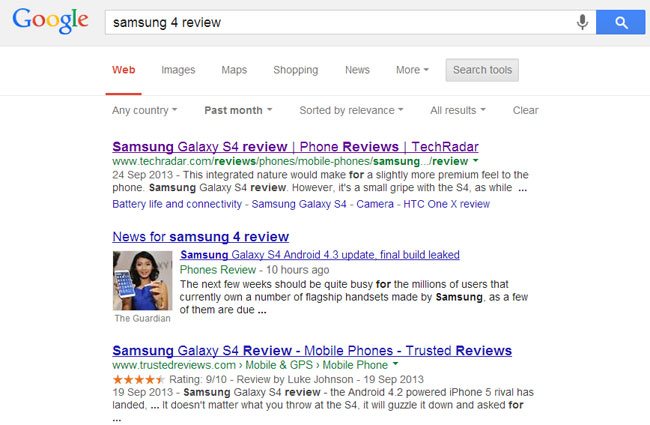
I would not have a big problem with this if articles were genuinely being refreshed, however they are not. The reviews are not updated with comparisons against phones that have been released during the seven month period after the phone’s launch. Nor have any articles got new opinions on whether the phone still offers value for money against newer phones or whether certain problems have become apparent to all Samsung S4 users after a few months of use. The articles simply have a small sentence or two added every month to make sure Google classifies the article as “Fresh”.
I do not profess to know how Google can address this. The freshness of an article should be a factor in search engine rankings, however websites that are getting high rankings are doing so due through making slight amendments. They are gaming the system too easily. When that happens, Google needs to act.
You may be thinking that “If you can’t beat them, join them”; however I do not want to spend all my time updating older articles when I could be focusing on new ones. Neither do I want to fool my readers into thinking that an article is newer either. Google needs to address this issue. I should not lose search engine traffic to my websites due to competitors constantly re-wording articles in order to fool Google. And as an internet user, I am sick of checking articles that are being promoted as being fresh, when in reality they are months or years old.
What has your experience of this issue been as a website owner as an internet user? Please leave a comment and give me your opinion on the issue.
Thanks for reading.
Kevin
Agree with you 100% on this Kevin. There are some bloggers in our niche that regularly change the published date on their old articles without making significant changes, just to give themselves an SEO boost. It’s one thing to update an article and show the original and updated dates, but it’s another to outright change the publication date without making significant changes to the article. It’s misleading and borderline black hat if you ask me because the intent is to fool people into thinking that it’s new. Sadly, it doesn’t seem like Google has cracked down on this yet, even in 2017. I hope they do because simply changing a published date to get a rankings boost is, as you put it, a gaping SEO hole and too easy to do. Very annoying indeed.
That is a fair point. Some websites handle it differently. A few keep the original date and print an updated date underneath. Some update the publication date and put a note underneath of when the article was originally published. I’d say most are simply changing the publication date; leaving the comment area as the only way to tell when an article was truly published.
I’m not sure…
There is a difference between merely updating an article by clicking ‘update’ and changing the publishing date. Why should anyone do the latter if not because of gaming the system, aka taking advantage of an obviously weak point of Google’s algorithms?? I don’t see any. But maybe I am overlooking something.
Regards from Greece,
David
I am not sure how they could be penalised. It’s not like they are actively selling links or breaking any terms and conditions. They could argue that they were legitimately updating their articles. Plus, all major websites are doing this. I doubt Google could hurt all of them as by doing so, they would hurt their own search engine rankings.
I’m sure this will come back to bite those who are abusing it. Google aren’t silly and should, and hopefully will address it soon and maybe those changes will penalise those abusing the system.
The publication date is changed as well.
Hold on a sec: When we say ‘update’ we don’t mean only update but also changing the publishing date — right?
Hi Kevin
For me this came as a surprise. I didn’t dare in the past to update older articles although I had reason to because I was afraid that Google would see this as manipulation and would punish a well rated article. Seems I was wrong…
Best regards from Greece,
David
hear, hear!
I agree Casey. I reckon Google will address the issue in the future. They definitely need to.
It’s a shame that webmasters abuse this, but then again if it’s open to abuse you bet it will be. That’s the bad side of Googles’ algo – it can be gamed.
Hopefully they fix this issue pretty soon.
The SERPs are looking more and more screwed up.